Letters from Skid Row

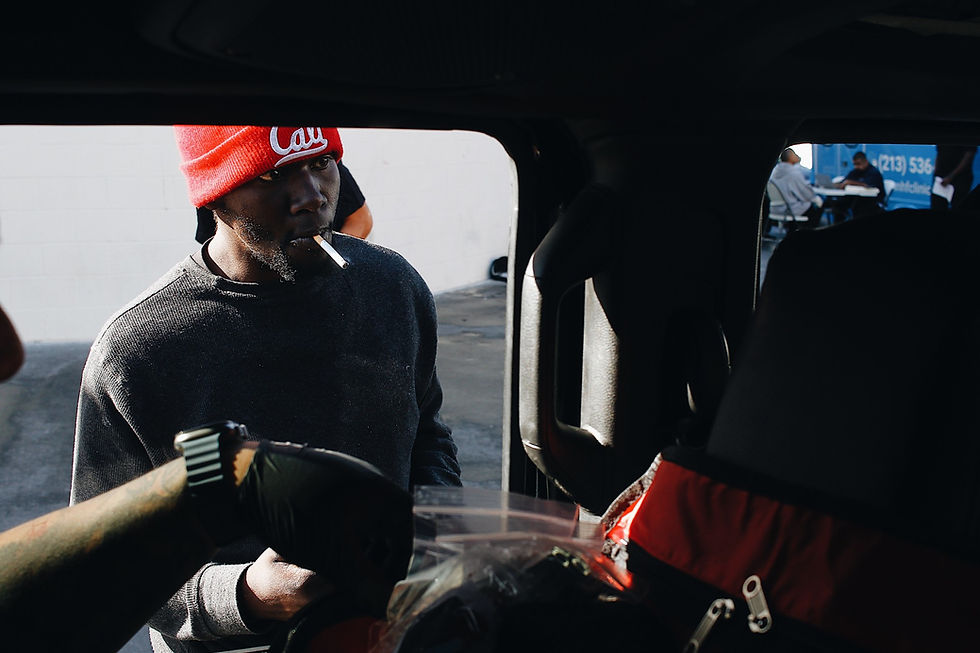
People ask why the Homeless Health Care Los Angeles Jeeps have no doors. We say, "To hop out fast when someone's overdosing." Here in Skid Row, everyone has a wound, and every second counts when people are dying. Every day we drive through Skid Row, oxygen tanks jingling in the trunk beside syringes of naloxone and an AED. What most people don’t know about us is that no one calls us to the scene.
We arrived by chance, when we found him behind the police station. The airway slid right into his mouth but his thick beard made it hard to seal our oxygen mask. To our relief, he threw up on our hands, and it seemed like the naloxone had worked. The skin peeled off our knuckles as we rubbed his sternum, but he was unresponsive. We placed our fingers on the carotid artery – there was no pulse.
We turned on the defibrillator and followed the robotic voice’s instructions, strapping it to his chest and continuing CPR until paramedics arrived. When the chest compressions and epinephrine shots failed, different emotions warred within me.
I thought about the man’s family, how they would feel knowing that in his last moments we tried our best to help. At the same time, I doubted myself. Could I have gotten there earlier? Could we have been more prepared? Though we all felt responsible, I knew the problem was bigger than any one of us.
In that moment, a familiar helplessness resurfaced, reminding me of my mom's long battle with cancer when I was 14, and her last breaths with me by her side. I remember the long rounds of chemotherapy and the frustration we all felt when they didn't work. I like to think that she would be proud to see me working at the same organization that she worked at for over 20 years, advocating for those in need. Through our work, I feel like I’m keeping her spirit alive.
At HHCLA, everyone has a story. It’s what gives the community hope that there’s a way out. You don't have to look very far to see proof of this from my coworkers, many of whom are former gang members. John, who served a life sentence for murder, often says, “No matter how many lives I save, I can’t make up for the life I took.” For him, redemption means giving grace when punishment fails to address health problems. He was given another chance, and he pays it – both forward and back – to the community.
In a place where violence and trauma are too common, people trust him more than clinicians. It’s just different when John makes referrals, “This place ain’t goin’ nowhere. Once you lose your finger, it’s gone forever. Go to the doctor.” For people who have been misunderstood for so long, it’s easier to listen to someone with lived experience.
People say our work must be overwhelming. When you work alongside people who’ve changed their life, it doesn’t feel like it. On breaks, we look up to the downtown buildings – the tallest buildings on the west coast – and back down to the sidewalk lined with encampments. So much is out of our hands. The Jeep is just around the corner.
About the Author
For 18 months, James Casanova was a member of the HHCLA Overdose Response Team before joining the Human Resources department. He is an incoming medical student at Meharry Medical College, class of 2030.